Waste Streams
A data-driven installation that visualizes Romania’s and Europe’s waste management systems as interconnected conveyor belts.
Published on February 1, 2023
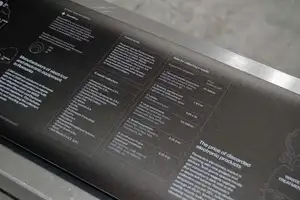
A data-driven installation that visualizes Romania’s and Europe’s waste management systems as interconnected conveyor belts.
Published on February 1, 2023
Waste Streams – Tracing Romania’s Tangled Trash is a data-driven installation that investigates the waste management system in Romania within a broader European context.
Presented as part of the exhibition Turn Signals – Design is not a Dashboard at the FABER Center in Timișoara, the project responds to a long-standing narrative in Romanian media that portrays the country as “the dump of Europe”. While large quantities of waste enter Romania through both legal and illegal channels, the destination and treatment of this waste often remain opaque.
Interactive installation at the Turn Signals – Design is not a Dashboard exhibition.
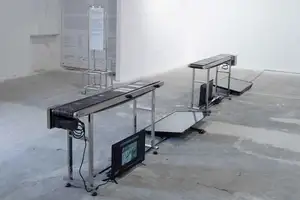
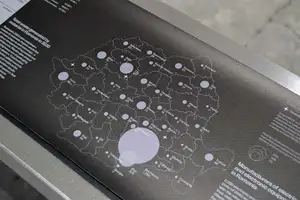
The installation takes the form of a waste sorting facility composed of two parallel conveyor belts. One belt represents Europe’s waste production, export strategies, and regulatory framework. The other focuses on Romania’s waste infrastructure and its environmental and public health impacts.
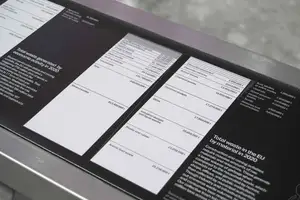
Together, the conveyors establish a visual comparison between two geopolitical scales. Statistics, policies, and legislation flow continuously along the belts, covering the period from 2004 to 2020. European data is drawn primarily from Eurostat, while the Romanian stream combines official datasets with investigative journalism and local knowledge.
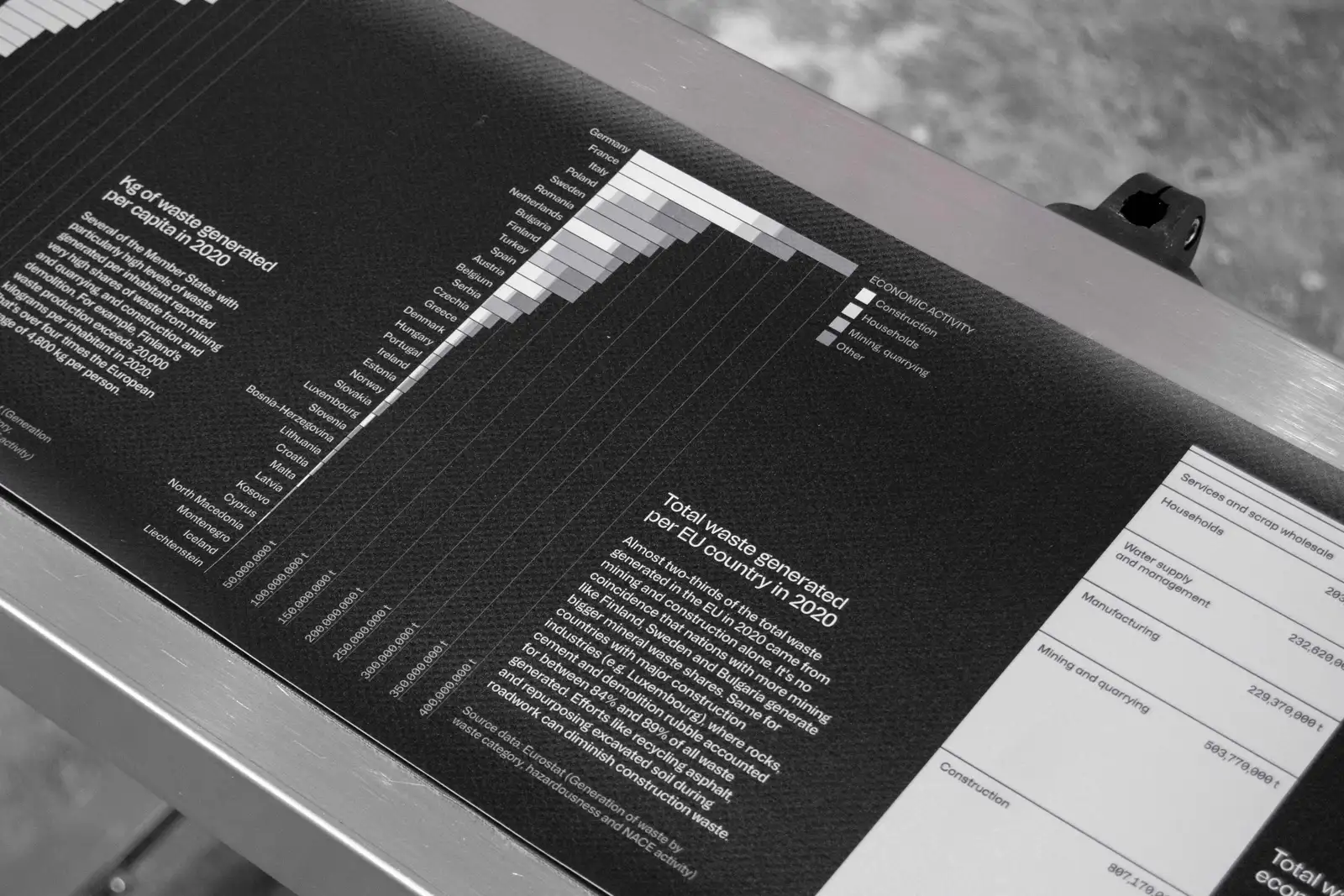
The twin conveyor belts visualizing European and Romanian waste systems
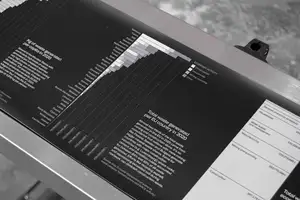
Each conveyor is structured around three chapters of waste management: generation, treatment, and export. The visualization highlights how waste quantities evolve over time, which sectors generate the most waste, and how different materials are treated or traded across borders.
Particular attention is given to e-waste, one of the fastest-growing waste streams in Europe. Romania’s collection and processing capacity remains among the lowest in the EU, largely due to the lack of dedicated facilities. Despite new directives and investments, landfills and cement kilns continue to play a central role in waste disposal.
The endless rotation of the conveyor belts acts as a metaphor for the waste life cycle. Far from being an endpoint, waste is presented as a commodity circulating in a global market, governed by economic interests, regulatory loopholes, and political power.
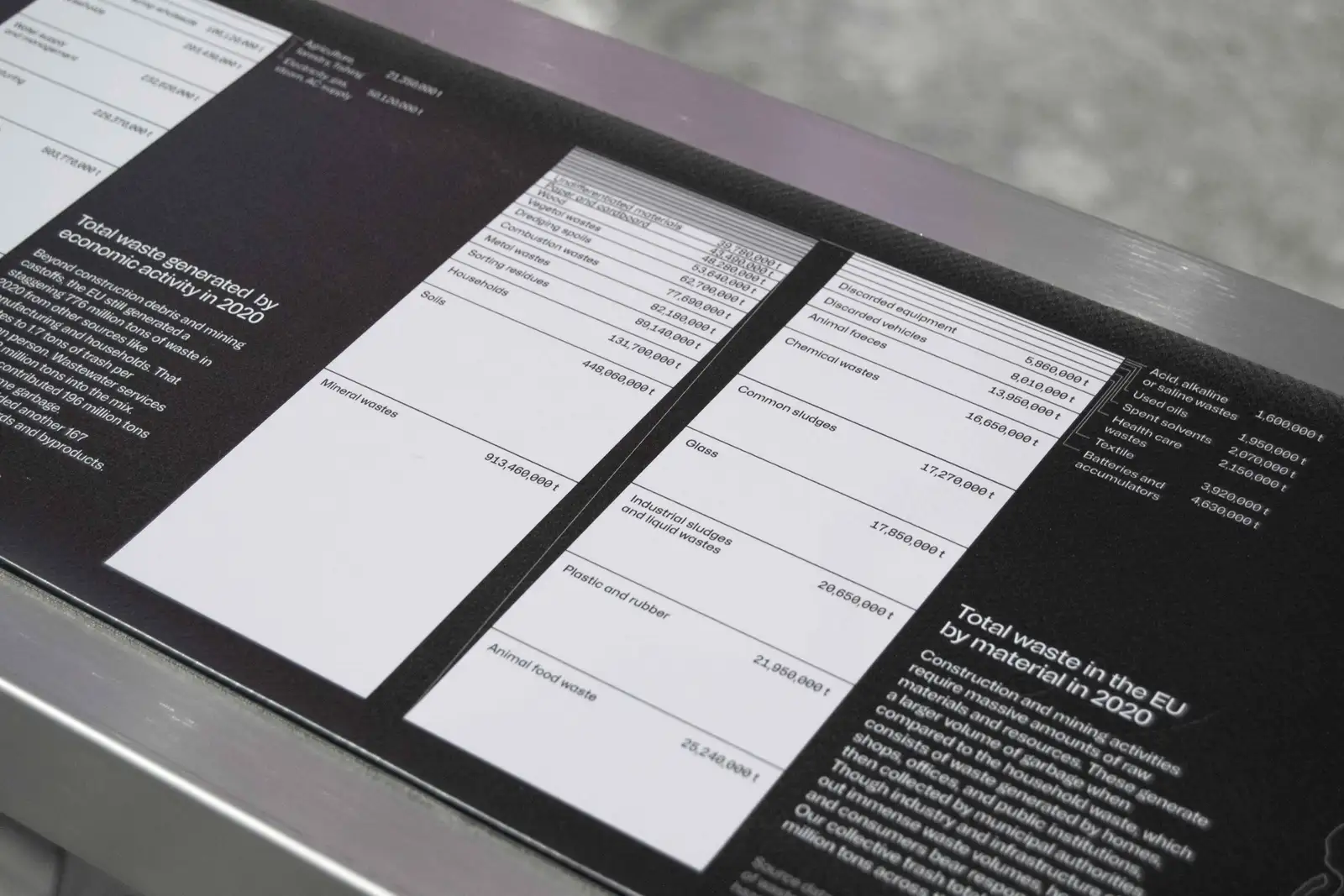
Detection screens beneath the conveyors contextualize the data with images and footage
Beneath the European conveyor, a screen displays a garbage segmentation dataset, offering visitors a technical reference point for the research. In contrast, the monitor below the Romanian belt shows CCTV footage of illegal dumping activities recorded around Timișoara, exposing the social and behavioral dimensions of waste management.
A final screen tracks the evolution of Romanian landfills, many of which were required to close under EU directives but remain poorly documented. These sites are often located near residential areas, disproportionately affecting marginalized communities and raising serious concerns about air, soil, and water contamination.
Developed in collaboration with Versavia Ancușa, Computer Science lecturer at the Polytechnic University of Timișoara, Waste Streams brings together data, design, and investigative research to reveal how waste operates as both an environmental burden and a traded resource.